



6 Ways How Room Acoustics for Rap Vocals Affect the Recording
Most independent rappers spend an enormous amount of time thinking about microphones. They compare specs, watch reviews, debate USB versus XLR, and save up for the mic they believe will finally make their vocals sound professional. What many of them do not realize how room acoustics for rap vocals has much influence on their vocal sound as the microphone itself.
Room acoustics are not an abstract concept reserved for high end studios. They are a physical reality that shapes every vocal recording, whether you are tracking in a bedroom, a closet, or a professional vocal booth. Understanding how sound behaves in a space is one of the fastest ways to improve your recordings without buying new gear. Even the best microphone for rap vocals will not sound right if the room itself is working against the recording, which is why understanding acoustics should come before upgrading gear.
Sound Does Not Only Come From Your Mouth
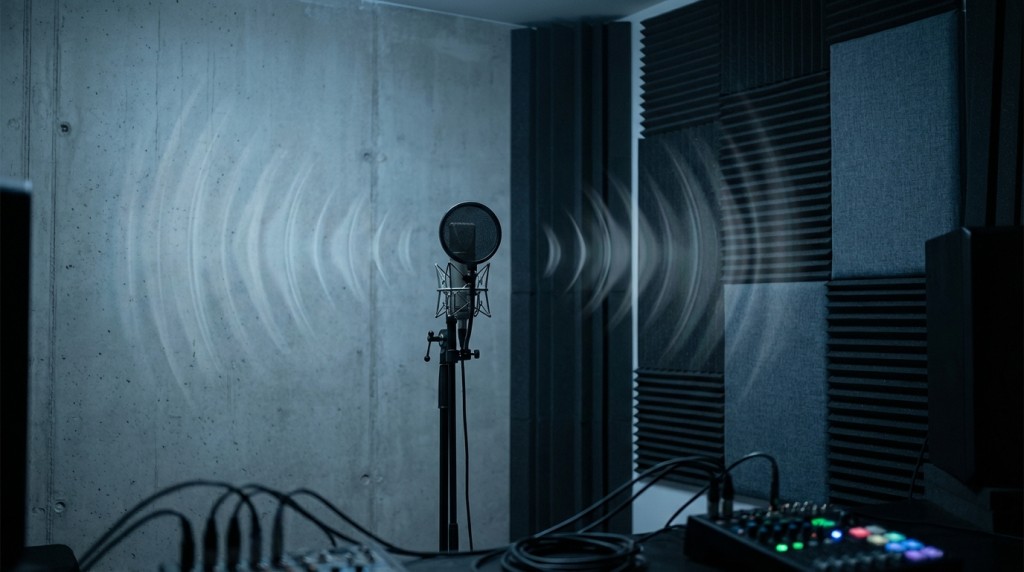
When you rap into a microphone, the mic is not only capturing your voice. It is capturing how your voice interacts with the room. Sound waves leave your mouth and travel outward in all directions. Some of those waves hit the microphone directly. Others hit walls, ceilings, floors, desks, windows, and furniture before bouncing back into the mic milliseconds later.
Those reflections are what define room acoustics.
In a well treated space, reflections are controlled. They arrive softer and later, or they are absorbed before they ever reach the microphone. In an untreated room, reflections arrive quickly and loudly, stacking on top of your direct vocal and changing its tone.
This is why two recordings made with the same mic can sound completely different depending on where they were recorded.
Why Rap Vocals Are Especially Sensitive to Room Acoustics
Rap vocals are dense, dynamic, and rhythmically precise. They often feature fast consonants, sharp transients, and consistent proximity to the microphone. This makes them especially vulnerable to acoustic problems.
Reflections blur articulation. Room resonance exaggerates certain frequencies. Early reflections can smear clarity and make vocals feel boxy or harsh. Low frequency buildup can make a vocal feel muddy even when the performance is tight.
Unlike sung vocals that may lean into reverb and space, rap vocals typically benefit from clarity and control. The room should disappear as much as possible.
The Difference Between Reflection and Reverb
One common misunderstanding is the difference between reflections and reverb. Reverb is a collection of many reflections arriving over time. In a small untreated room, what you hear is not pleasant reverb. It is early reflections and flutter echo.
Early reflections happen when sound bounces off nearby surfaces and returns to the microphone almost immediately. These reflections interfere with the direct sound, causing comb filtering. This changes the tone of the vocal in unpredictable ways.
Flutter echo happens when sound bounces back and forth between parallel surfaces, like two bare walls. This creates a ringing or metallic tail that becomes very noticeable on spoken or rapped vocals.
These issues are not solved in mixing. They are baked into the recording.
How Room Size and Shape Influence Your Sound
Small rooms tend to exaggerate certain frequencies. This is due to standing waves, which occur when sound waves bounce between surfaces and reinforce specific frequencies based on the room’s dimensions.
Bedrooms often have strong low mid buildup around the 150 to 300 Hz range. This can make rap vocals feel boxy or congested. Larger rooms can reduce some of this buildup but may introduce longer decay times if untreated.
Ceiling height matters. Low ceilings cause reflections to return quickly, which can make vocals sound closed in. High ceilings allow reflections to spread out over time, which can sound more natural if controlled.
The shape of the room also plays a role. Perfectly square rooms tend to have more severe standing wave issues. Rectangular rooms are generally easier to work with.
Why Closets Sometimes Work and Sometimes Do Not
Many rappers record in closets because the clothes act as natural absorption. This can work, but it is not a guaranteed solution.
Clothes absorb high frequencies well, which can reduce harsh reflections. However, they do very little for low frequencies. This can result in vocals that sound dull on top but still muddy in the low mids.
Closets also tend to be very small, which increases proximity effect and bass buildup when using directional microphones. If the mic is too close to reflective surfaces, the benefit of absorption is reduced.
A closet can be a workable solution if treated intentionally, but it should not be assumed to be acoustically perfect by default.
The Role of Absorption Versus Soundproofing
Another common confusion is between sound treatment and soundproofing. Absorption improves how your room sounds inside. Soundproofing prevents sound from leaving or entering the room.
Most home studios cannot be fully soundproofed without construction. That is okay. For vocal recording, absorption is far more important.
Absorption materials reduce reflections by converting sound energy into heat. This prevents sound from bouncing back into the microphone. The most effective absorption for vocals targets mid and high frequencies, with some control over low mids.
Foam panels, mineral wool, fiberglass panels, and even thick blankets can be used strategically. Placement matters more than quantity.

Where to Treat First for Rap Vocals
The most important area to treat is the space directly behind and around the microphone, not behind the artist. Sound travels past the microphone, hits the wall behind it, and reflects back into the mic.
Treating the wall behind the mic reduces early reflections significantly. Treating the side walls at the point of first reflection also helps. The ceiling above the mic is often overlooked but can be a major source of reflections in rooms with low ceilings.
You do not need to cover every surface. Strategic placement creates the biggest improvement.
Why Directional Microphones Make Acoustics More Obvious
Most rap vocals are recorded with cardioid microphones. These microphones are designed to reject sound from the rear, but they still pick up reflections from the front and sides.
This means the mic hears the room more than people expect. Directional mics also emphasize proximity effect, which boosts low frequencies when the artist is close to the mic. In an untreated room, this can exaggerate bass buildup.
Learning how your mic interacts with your room is part of the recording process. Moving the mic a few inches can change how much room tone is captured.
Distance and Performance Matter
Room acoustics do not exist independently from performance. How close you stand to the mic affects how much room sound is captured. Closer distances increase direct sound and reduce room influence, but also increase proximity effect.
Pulling back slightly can reduce bass buildup, but it also allows more room sound into the recording. There is a balance point that depends on your voice, your mic, and your room.
Experienced engineers adjust mic distance as part of acoustic control. This is something independent artists can learn with experimentation.
Why Mixing Cannot Fix a Bad Room
Equalization can reduce some frequency issues, but it cannot remove reflections. Compression can make room problems more noticeable by raising the level of reflections between phrases.
Reverb plugins cannot replace controlled acoustics. Adding artificial reverb on top of uncontrolled room sound often makes vocals feel messy and undefined.
Clean recordings start with the room. Mixing enhances what is already there. It does not undo acoustic problems.

Practical Improvements Without Major Investment
You do not need a professionally designed studio to improve your recordings. You need awareness and intention.
Recording away from corners helps reduce bass buildup. Facing into the room rather than toward a wall can change reflection patterns. Using portable absorption panels or even thick moving blankets behind the mic can dramatically reduce early reflections.
Listening critically to test recordings is essential. Clap your hands in the room and listen for ringing. Record spoken vocals and listen for boxiness or harshness. Make small adjustments and test again.
Room acoustics are learned through listening, not theory alone.
Why Understanding Acoustics Builds Confidence
When artists understand why their vocals sound the way they do, frustration decreases. Instead of blaming gear or performance, they can identify environmental factors and address them.
This knowledge leads to consistency. You know what to expect when you hit record. You trust your setup. That confidence translates into better performances.
Rap vocals benefit from confidence as much as technique.
Final Thoughts
Room acoustics are invisible, but they are always present. They shape every recording before it ever reaches your DAW. Ignoring them is one of the biggest reasons home recordings feel amateur, even when the performance is strong.
The good news is that acoustics are not mysterious. They are physical, understandable, and manageable at any level. With a basic understanding and a few intentional changes, your room can work with you instead of against you.
The microphone captures what the room allows it to hear. When the room is controlled, your voice becomes the focus. And that is where rap vocals are meant to live.