




Most independent artists do not have a music problem.
They have a file entropy problem
Effective music release asset management is one of the most overlooked systems in an independent artist’s career, yet it can prevent costly mistakes and lost opportunities.
Every release multiplies complexity. New session files. Alternate mixes. Clean versions. Artwork revisions. Vertical edits. Lyric sheets. Contracts. Metadata. Distribution exports. What begins as a single idea slowly becomes a digital sprawl.
Then one day you need something simple. The final master. The clean edit. The exact cover art that was delivered to distribution. And suddenly you are digging through folders labeled “New Mix,” “Final Mix,” “Final Mix 2,” and “Use This One.”
Release asset management is not glamorous. It does not show up on Instagram. It does not feel creative.
But it is one of the quiet disciplines that separates sustainable artists from constantly overwhelmed ones.
Release asset management is simply the practice of ensuring that every file connected to a release can be found quickly by the right person, whether that person is you, a collaborator, a distributor, or your future self two years from now.
When assets are messy, everything slows down. Approvals take longer. Revisions feel heavier. Distribution uploads create anxiety. Content repurposing becomes friction. Even licensing and monetization opportunities can be lost because the right file cannot be located fast enough.
A clean archive is leverage you do not have to subscribe to.
This is operations guidance, not legal, tax, or financial advice. For legal and tax questions, consult a qualified professional.
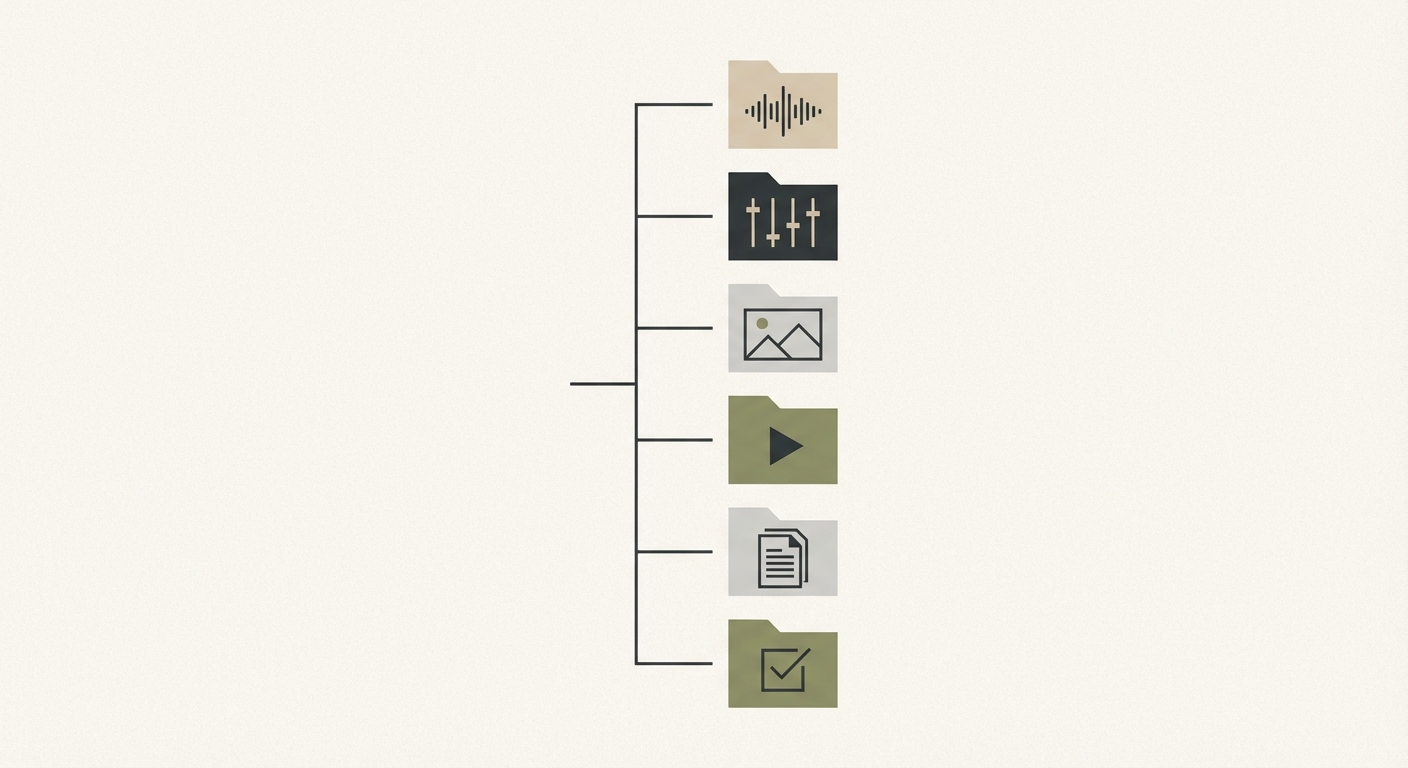
The outcome you want: one source of truth per release
The goal of release asset management is not perfection. It is clarity.
Every release should have one consistent home. One location where context lives. One place where audio, visuals, documents, and delivery assets are housed together. If you cannot point to a single folder and say, “Everything for this release lives here,” your system is fragile.
That home should contain four core categories.
First, audio. Final masters, clean and explicit versions, instrumentals, radio edits, stems, and session files. Not scattered across desktops or buried inside temporary bounce folders.
Second, visuals. Cover art source files. Final exports for distribution. Social promo graphics. Video edits. Thumbnails. Shortform exports.
Third, documentation. Split sheets. Metadata. Release plans. Lyric sheets. Collaborator notes. Licensing agreements.
Fourth, deliverables. The exact files uploaded to your distributor. The YouTube-ready export. Press kit folders. Ad-ready creatives.
If any of those live somewhere else “for now,” you will eventually pay for it. Usually in stress. Sometimes in real money.
Release asset management is about eliminating that future tax.
A folder structure that scales (even if you work alone)
A simple release structure that works for singles, EPs, and albums should be chronological and clearly labeled. Start with a master “Releases” directory. Inside it, organize by year. Inside the year, create folders that begin with the release date in ISO format. Then add artist name and project title.
For example, a folder might read:
2026-03-15 – ArtistName – TrackTitle (Single)
Leading with the date keeps releases in chronological order across devices. Adding artist and title prevents ambiguity when multiple collaborators share drives.
Inside each release folder, divide by category.
Releases/
  2026/
    2026-03-15 - ArtistName - TrackTitle (Single)/
      01_Admin/
      02_Audio/
        Masters/
        Stems/
        Sessions/
      03_Artwork/
        Source/
        Exports/
      04_Video/
        Edits/
        Captions/
        Thumbnails/
      05_Content/
        Shortform/
        Longform/
      06_Deliverables/
        Distributor/
        PressKit/
        Ads/
The numbering forces consistent ordering across devices and collaborators. People cannot casually invent new folder logic because the structure is already visible and predictable.
Within 02_Audio, separate Masters, Stems, and Sessions. Within 03_Artwork, separate Source files from Exports. Within 04_Video, separate Edits, Captions, and Thumbnails.
Release asset management is not about memorizing names. It is about creating a system where the names become predictable.
Naming Conventions That Prevent Expensive Confusion
File naming is where entropy usually wins.
The phrase “final_final_v3_reallyfinal.wav” is not harmless. It is a symptom of unclear version control.
You do not need enterprise naming standards. You need boring consistency.
A strong export naming structure might look like this:
ArtistName_TrackTitle_Version_SampleRate-BitDepth_Date.ext
For example:
DonteCrooks_StayWhole_Explicit_48k-24b_2026-02-11.wav
You can add BPM and key if relevant. The essential pieces are artist name, track title, version identifier, and export date.
Dates matter. They eliminate guesswork. They eliminate arguments. They eliminate the mental gymnastics of remembering which version was “the good one.”
Release asset management thrives on clarity, not creativity, when it comes to filenames.
Naming conventions: boring rules that prevent expeCollaboration Without Chaos
Collaboration multiplies entropy. Each new voice introduces new file names, new exports, new interpretations of “final.”
Three simple disciplines keep collaborative projects clean.
First, only one person exports masters. Everyone else exports reference files. This prevents competing “final masters” from circulating.
Second, references live in a dedicated Ref folder. Feedback should always attach to files that exist inside the structured system. Feedback on files floating in email threads creates invisible work.
Third, lock naming conventions once distribution metadata is submitted. Changing file names after distribution begins increases error risk. It introduces mismatches between metadata, ISRC assignments, and upload versions.
Release asset management is not about control. It is about preventing confusion before it happens.
Version Control Without Becoming a Software Company
Version control sounds intimidating. It does not need to be.
At its simplest, version control is the discipline of intentional change.
Inside your Admin folder, maintain a simple Changelog document. A plain text file is enough. Each time a major revision occurs, note the date and what changed. This creates a narrative history of the release.
For session files, never overwrite. Duplicate and date stamp before making major changes. Storage is cheaper than rebuilding lost work.
For deliverables, create a subfolder labeled LOCKED once assets are finalized and submitted. This protects against accidental overwrites.
Release asset management is not about complexity. It is about reducing cognitive load.
When files are organized, your brain stays focused on music, not memory reconstruction.
Metadata Is an Asset
Files are not the only assets that matter. Information attached to those files matters just as much.
Every release should include a single Release Info document. This document should contain final title, artist name formatting, featured artists, producer and writer credits, explicit flags, lyrics, release date, time zone, and distribution codes such as ISRC or UPC when assigned.
This document becomes the source of truth for distributor uploads, YouTube descriptions, press kits, lyric platforms, and email announcements.
Without centralized metadata, small inconsistencies creep in. A featured artist spelled slightly differently on YouTube. A missing credit on streaming platforms. A mismatched release date.
Release asset management is about aligning files and information in one predictable place.
Where This Fits in Your Release System
Release asset management is not an isolated task. It feeds everything else.
It feeds your launch SOP. It feeds your content production schedule. It feeds your ad exports. It feeds your analytics tracking.
When asset management is clean, release week becomes execution, not excavation.
After launch, organized assets allow you to repurpose content months later without friction. A clean stem folder allows for remix opportunities. A well-documented split sheet simplifies sync placements. A structured artwork archive accelerates merch design.
Release asset management is not backward-looking. It is forward-protective.
Shared Does Not Mean Owned
One of the most overlooked risks in independent music careers is ownership confusion.
Shared drives and collaborator folders feel convenient. They are not ownership.
Always maintain a private master archive that you control. Even if you collaborate heavily, your core release archive should exist in a location that is independent of any one partner.
If a collaborator leaves, you should not lose your access to the history of your own work.
Release asset management protects autonomy.
The Emotional Side of Organization
There is a psychological shift that happens when your release archive is clean.
You stop hesitating before opening folders. You stop dreading revisions. You stop losing small pockets of time to digital scavenger hunts.
The creative process feels lighter because the operational process feels stable.
Artists often resist systems because they fear rigidity. But release asset management is not rigidity. It is infrastructure.
It is the scaffolding that allows creative risk without administrative collapse.
A Practical Reset
If your archive is messy, do not attempt to fix everything at once.
Start with your next release. Create the structure before the first final export exists. Commit to naming conventions from day one. Keep the Release Info document updated as decisions are made.
Then, over time, retroactively clean past releases during quiet weeks.
Release asset management compounds. Each clean release makes the next one easier.
The Bottom Line
A clean release archive is not busywork. It is momentum protection.
Opportunities arrive without warning. A sync request. A remix opportunity. A label inquiry. A media feature. When they do, your ability to respond quickly matters.
Release asset management ensures you are ready.
Your future self will either thank you for clarity or curse you for chaos.
The choice is operational.
And operational discipline is one of the most underrated advantages an independent artist can build.