
Independent Artist Automations: Building a Tool Stack That Works for You Instead of Against You
Tools are supposed to create leverage.
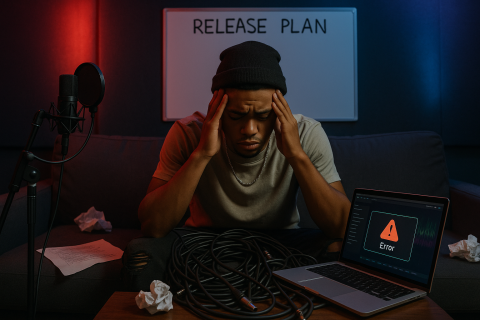
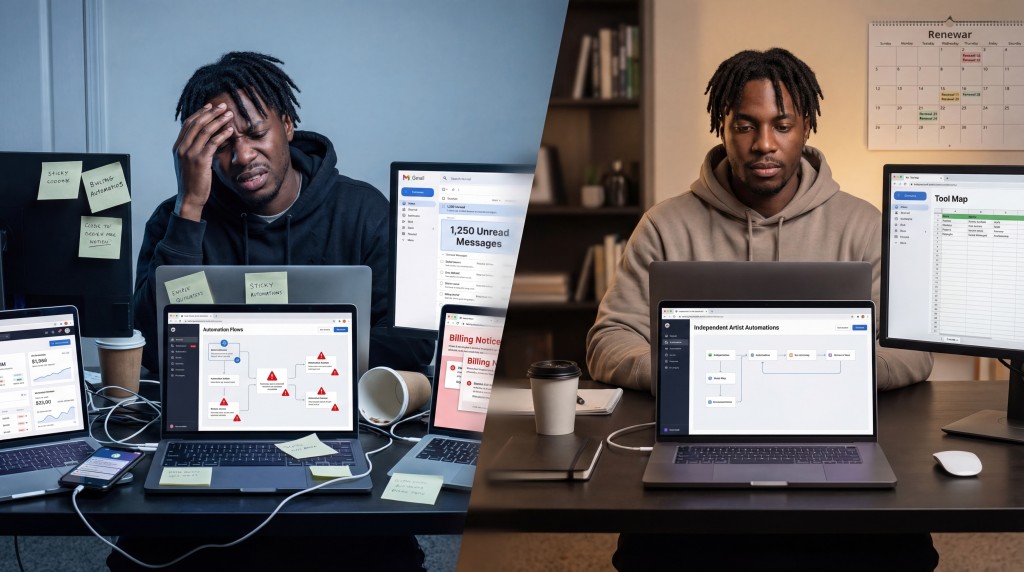
That is the promise. Automate the busy work. Connect the systems. Free up time so you can focus on the music, the brand, the movement. Yet for most independent artists, the opposite happens. The tool stack grows faster than the audience. Subscriptions pile up. Automations break quietly in the background. Passwords live in old emails. Nobody remembers who owns what.
What started as leverage turns into maintenance.
Independent artist automations only work when they are intentional. Without governance, they create dependency. Without structure, they create stress. And without clarity, they quietly drain both money and attention.
This is not about being anti-technology. It is about maturity. It is about running your creative career with discipline.
This article is operations guidance, not legal or tax advice. For contract, compliance, or financial questions, consult a qualified professional.
The First Principle: Automations Should Serve KPIs and SOPs
Independent artist automations should never exist in isolation.
If a tool does not improve a measurable KPI or make an SOP easier to execute, it is not leverage. It is entertainment. It may feel productive. It may look advanced. But if it does not move something that matters, it is noise.
Before adding any automation, you should be able to answer two simple questions.
Which KPI does this improve?
Which SOP step does this reduce or simplify?
If you cannot answer both clearly, you are not adding infrastructure. You are adding complexity.
Many artists adopt automations because they saw someone else using them. A funnel builder. A new CRM. A scheduling tool. A social automation platform. The problem is not the tool itself. The problem is installing it without a system it supports.
Independent artist automations only create leverage when they sit on top of stable foundations.
The Five Core Systems Most Artists Actually Need
Strip away the hype and you will find that most independent artists only need five stable systems to operate effectively.
First, identity and website. This is your home base. It is where you control the narrative, collect information, and define your brand without algorithm interference.
Second, email or SMS capture. This is your owned audience. Automations here should focus on welcome sequences, segmentation, and consistent communication.
Third, commerce. Merch, digital products, tickets, services. This system processes money and must be stable, secure, and clearly owned.
Fourth, storage and asset management. Masters, cover art, contracts, exports, templates. If these are scattered across personal drives and old accounts, your operations are fragile.
Fifth, analytics and reporting. You do not need enterprise dashboards. You need enough visibility to make weekly decisions.
Independent artist automations should strengthen these five systems. They should not distract from them.
Vendor Evaluation: The Discipline Most Artists Skip
Adding a tool should feel like signing a contract. Because in many ways, it is.
Before adopting a new platform, answer the following in writing.
What outcome does this tool improve?
Which workflow step becomes easier because of it?
Who owns the account? Not who uses it. Who owns it.
Can you export your contacts, orders, and data easily?
What breaks if the tool goes down?
How do you leave without losing your audience or revenue?
If you cannot answer these questions, you are not choosing a tool. You are adopting a dependency.
Independent artist automations fail most often because exit planning never happens. Artists think about setup. They rarely think about migration.
Mature operations consider both.
Subscription Creep Is Not Just About Money
Subscription creep is quiet. Ten dollars here. Thirty dollars there. An annual plan you forgot about. A feature you barely use.
But the cost is not only financial. It is cognitive.
Every additional tool brings settings. Notifications. Logins. Updates. Integration troubleshooting. Mental overhead.
Independent artist automations should reduce attention load, not increase it.
Create a simple rule. If you add a tool, you remove or downgrade another within thirty days. This forces intentionality. It prevents accumulation.
Once a month, spend fifteen minutes auditing subscriptions. Cancel anything unused. Downgrade anything that no longer aligns with current goals.
Avoid paying annually for tools you have not proven useful over at least ninety days. Optimism is not a budgeting strategy.
Automation: When It Helps and When It Hurts
Automation is powerful when it removes manual steps and reduces errors.
It becomes dangerous when it creates invisible complexity.
Good independent artist automations follow predictable patterns.
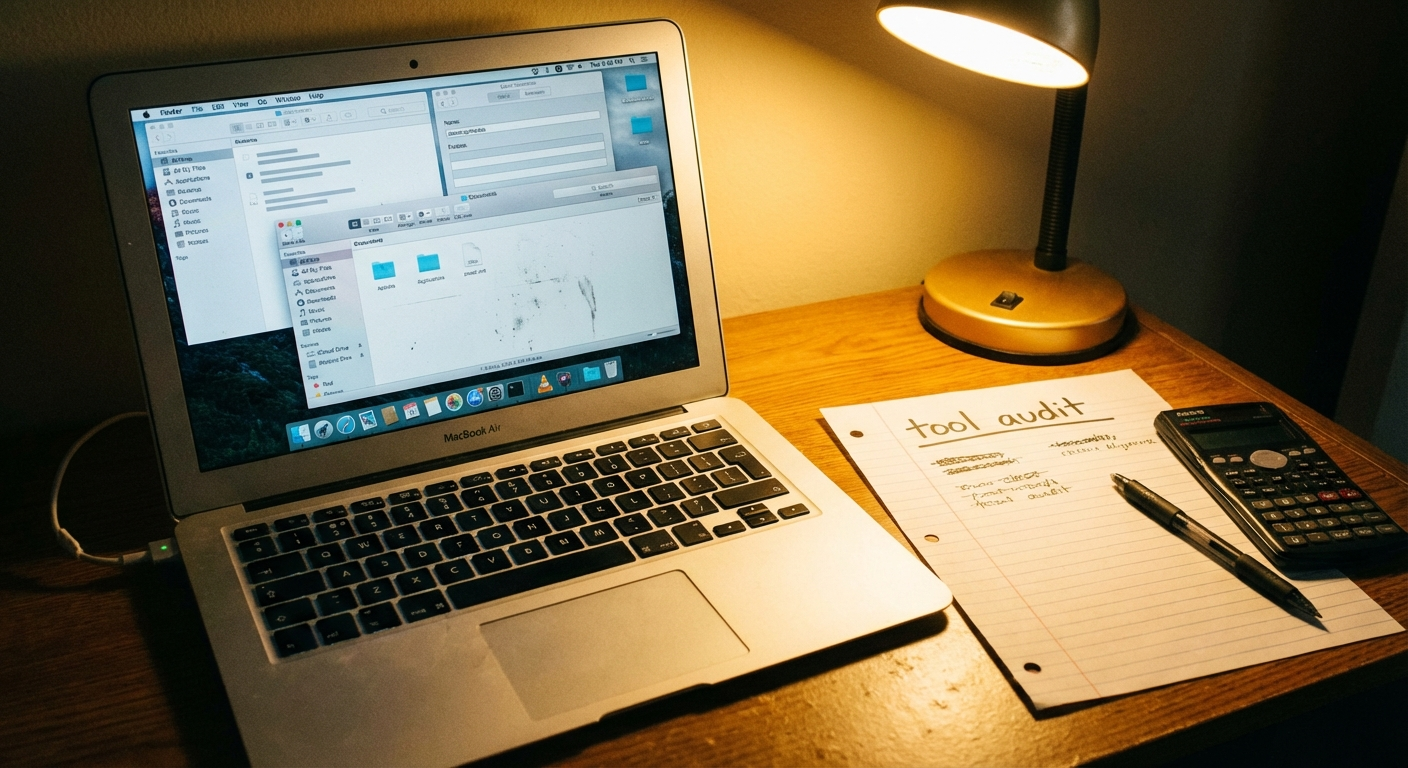
A new subscriber signs up. They are tagged. A welcome sequence begins automatically.
An order is placed. The buyer is segmented. A post-purchase email series delivers expectations and next steps.
A new piece of content goes live. It triggers a notification to your email list or logs into your reporting sheet.
These automations remove repetitive tasks. They standardize communication. They protect consistency.
Bad automations are harder to spot.
Anything that requires daily troubleshooting is a red flag.
Anything that makes your messaging feel robotic or disconnected from your voice should be reconsidered.
Anything you cannot explain to a collaborator in sixty seconds is probably too complex for your current scale.
Independent artist automations should feel simple when viewed from a distance. If they require constant attention, they are not automation. They are disguised labor.
Governance: Ownership, Access, and Continuity
This is where professional discipline separates hobby from business.
Account ownership must live under a business email, not a personal account tied to a single device.
Multi-factor authentication should be enabled on core tools. Email, website, store, payment processors. These are non-negotiable.
Access levels should follow least-privilege principles. Assistants get access. They do not get ownership.
Billing should run through one controlled account or card with clear labeling. Random charges from forgotten subscriptions create financial fog.
Renewal dates should be documented in a simple calendar.
Data exports should happen periodically. Email lists, order histories, analytics summaries. Not because you plan to leave, but because continuity matters.
Independent artist automations are only as strong as their recovery plan.
Account loss has destroyed more momentum than poor marketing ever has.
Mapping Your Tool Stack
Most artists do not know their full stack until something breaks.
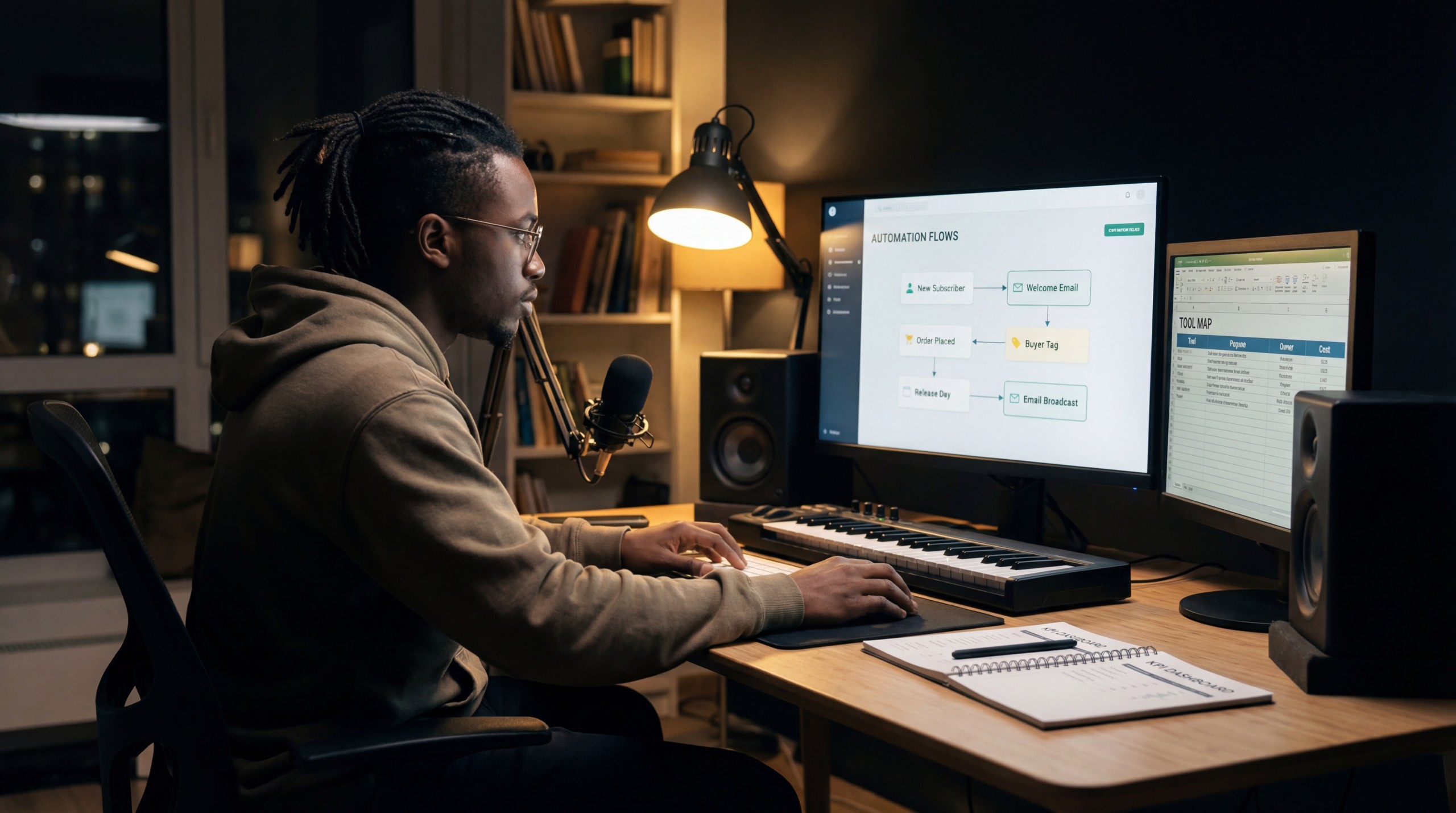
Create a single document or spreadsheet tab labeled Tool Map. List every platform. Website host. Email provider. Store. Analytics tool. Cloud storage. Payment processor. Automation connector. Security platform.
For each tool, document its purpose, owner, monthly cost, renewal date, data export path, and which KPI or SOP it supports.
This is not bureaucracy. It is clarity.
Independent artist automations thrive when visibility exists. When everything is documented once, it stops living in your head.
Update the map monthly. Five minutes is enough.
A Simple Decision Tree
When you are unsure about keeping or adding a tool, use a structured decision tree.
Do we use it weekly? If not, can we downgrade or remove it?
Does it move a KPI? If not, it is a luxury. Treat it as one.
Does it reduce steps in an SOP? If not, it likely adds complexity.
Can we export our data easily? If not, dependency risk increases.
Is there a simpler alternative? If yes, test before renewing.
Independent artist automations should be judged by clarity, not novelty.
Security and Continuity: The Boring Advantage
The artists who last are rarely the most technologically flashy. They are the most operationally stable.
Use business emails for core accounts.
Enable multi-factor authentication.
Document recovery emails and phone numbers.
Separate contractor access from ownership.
Back up critical assets.
Independent artist automations are not about speed alone. They are about durability.
A single compromised account can erase years of progress. Basic security discipline prevents that.
The 90-Minute Automation Audit
You do not need months to clean your stack. You need one focused session.
List every subscription and renewal.
Assign each tool to a KPI or SOP. If it cannot attach clearly, it becomes a removal candidate.
Cancel or downgrade three tools immediately. Start small. Build momentum.
Document ownership and export paths for the remaining core systems.
Create one automation that removes a recurring weekly task.
Stop there.
Independent artist automations should be layered gradually. Discipline first. Expansion second.
The Real Goal
Tool stack governance is not about being cheap. It is about being clean.
Independent artist automations should make your career lighter. They should protect your time. They should create predictable workflows that allow creativity to expand.
When your stack is clean, you think clearly.
When your automations are aligned, you move consistently.
When your systems are documented, you reduce anxiety.
Tools should serve the work.
The work should serve the life.
If the stack feels heavier than the music, something is misaligned.
Clean it up. Tighten it. Simplify it.
Independent artist automations are not about sophistication. They are about sustainability.
And sustainability is what turns momentum into legacy.