

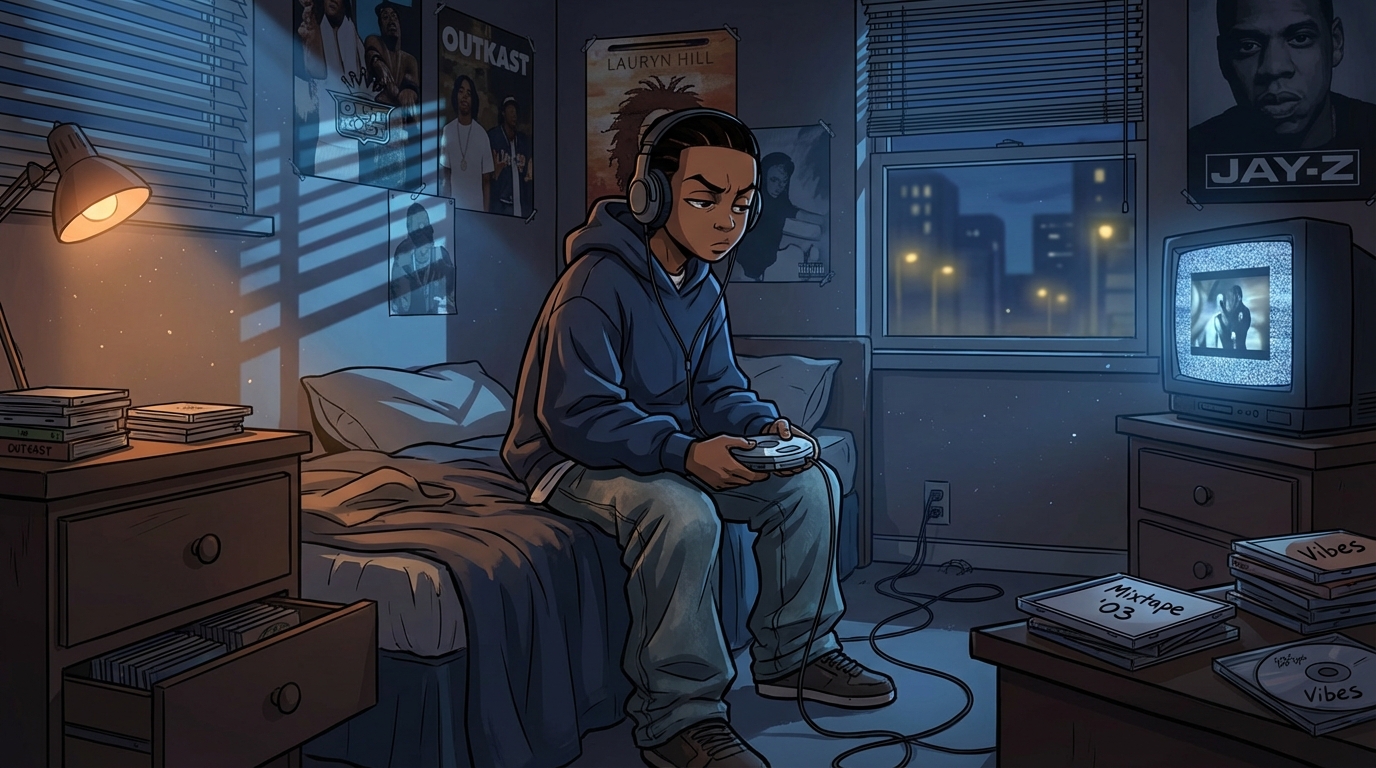
I don’t know exactly when it changed. I just know that one day music stopped feeling like a place you went to and started feeling like something you scrolled past. The early 2000s were different. Not because the artists were perfect or the industry was fair, but because music still had weight. It had patience. It had mystery. It felt earned.
Back then, you didn’t hear everything at once. Songs arrived in your life slowly. You caught them on the radio during a late-night drive, or playing faintly from a friend’s room while you waited outside. You heard them blasting from someone’s car at a red light and wondered who the artist was because Shazam wasn’t a reflex yet. Music made you curious. It asked you to sit with it instead of skipping to the next thing.
There was a feeling of anticipation that doesn’t really exist anymore. Album release days mattered. You knew the date. You waited for it. You might have gone to the store or burned a CD from someone who already had it. You read the tracklist and imagined what the songs might sound like before you ever heard them. That waiting did something important. It made the music feel intentional. It gave it space to mean something.
The early 2000s were loud and quiet at the same time. Loud in style, confidence, and expression. Quiet in the sense that not everyone had a platform. Artists didn’t feel constantly accessible. You didn’t know what they ate for breakfast or how they felt about every trending topic. You knew them through the music, the videos, the interviews that felt rare. That distance made the connection stronger, not weaker.
Music videos were events. You remember sitting through commercials just to catch the one song you hoped would come on. The visuals weren’t just content. They were worlds. Entire aesthetics lived inside those few minutes. You could feel the budget, the intention, the storytelling. Even the low-budget videos felt personal, like you were being invited into something raw instead of sold something polished.
The songs themselves carried emotion differently. You could hear struggle in voices that were not trying to sound perfect. You could hear hunger, confidence, confusion, joy, heartbreak. Artists were not afraid to sound human. Not every song was designed to fit a playlist or a trend. Some tracks were too long. Some intros took their time. Some songs didn’t even start the way you expected. And somehow, that made them better.
There was also something special about how music fit into everyday life. You had songs for the bus ride to school, songs for being home alone, songs for late nights, songs that felt like secrets between you and the world. Music became attached to moments. Certain tracks still take you back instantly to a room, a smell, a version of yourself that existed only then.
You didn’t need to brand yourself to love music. You didn’t need analytics to tell you whether a song mattered. If it hit, it hit. If it didn’t, it didn’t. Taste felt personal. Discovering something new felt like finding treasure, not chasing relevance. There was no pressure to turn every passion into content.
Artists were allowed to grow in public without being dragged for it. Albums didn’t need to outperform the last one in the first week to be considered successful. Careers felt like journeys, not competitions. There was room to experiment, to disappear for a while, to come back changed. Fans followed because they cared, not because the algorithm reminded them to.
I think about how much silence existed around music back then. Silence between releases. Silence between moments. Silence that made the sound feel louder when it finally arrived. Today, everything is noise. Everyone is posting. Everyone is promoting. Everyone is performing all the time. The pressure to stay visible has replaced the permission to be present.
That constant visibility has changed how music feels. It’s harder to separate the art from the marketing. Harder to just sit with a song without thinking about how it fits into a bigger strategy. Harder for artists to protect the parts of themselves that once made the music honest.
But even with all that, the feeling is not gone. It’s just buried. You can still hear it when an artist stops chasing and starts telling the truth. You can feel it when a song doesn’t sound like it was designed to win, but designed to be felt. The early 2000s remind us that music does not need permission to be meaningful. It only needs sincerity.
That era wasn’t perfect. The industry was flawed. Access was limited. Many voices were overlooked. But there was a soul to the process that we should not forget. Music was allowed to breathe. Artists were allowed to be private. Fans were allowed to fall in love slowly.
This is not a letter about wanting to go backward. It’s about remembering what mattered so we don’t lose it completely. Technology gave us incredible tools. Independence is more possible now than ever. But progress doesn’t mean abandoning patience, mystery, or depth. It means learning how to carry them forward.
When music felt different, it wasn’t because of the year. It was because of the relationship. The relationship between the artist and the listener. Between silence and sound. Between intention and expression. That relationship still exists for those willing to protect it.
So this letter is a thank you. To the songs that raised us. To the albums that taught us how to feel. To the moments when music didn’t need to be explained, optimized, or justified. It just existed, and that was enough.
And maybe, if we remember that feeling, we can build something new that still carries the same soul.